
Madeira

Secretaria Regional de Saúde e Proteção Civil, is the Regional Health authority in Madeira, one of the adoption sites where the xShare Yellow button will be adopted using the European Electronic Health Record Exchange Format (EEHRxF), thus the Electronic Health Record (EHR) sharing will be consolidated in this region through the development of networks and ecosystems that will contribute to the robustness of the European Health Data Space (EHDS). Madeira presents a population of approximately 250,000 inhabitants, supported by 3 public hospitals along with 47 health centres, providing community, primary and secondary care, emergency services, and inpatient mental health care. Each patient is assigned a unique EHR that consolidates all medical and socio-clinical information. To date, the Regional Health Service has recorded over 599,804 EHRs and more than 57.4 million clinical care episodes.
Madeira’s aim in this project is to bring healthcare professionals and citizens closer, equipping health institutions with innovative, interoperable, and intelligent solutions that enhance the delivery of care.
By integrating the xShare Yellow button, patients will gain seamless access to their health information, while interoperability between healthcare providers is assured, fostering a single, secure, and standardized digital health market across Europe.
This approach promotes patient empowerment, active participation in healthcare management, and creates synergies for a truly integrated, high-quality, and sustainable healthcare system.
Personas - use cases
Priority categories
International Patient Summary (IPS)
Yellow Button basic functionalities
Download (PDF; FHIR)
Architecture
Considering the reference architecture, in the case of this adoption site, the following blocks are considered:
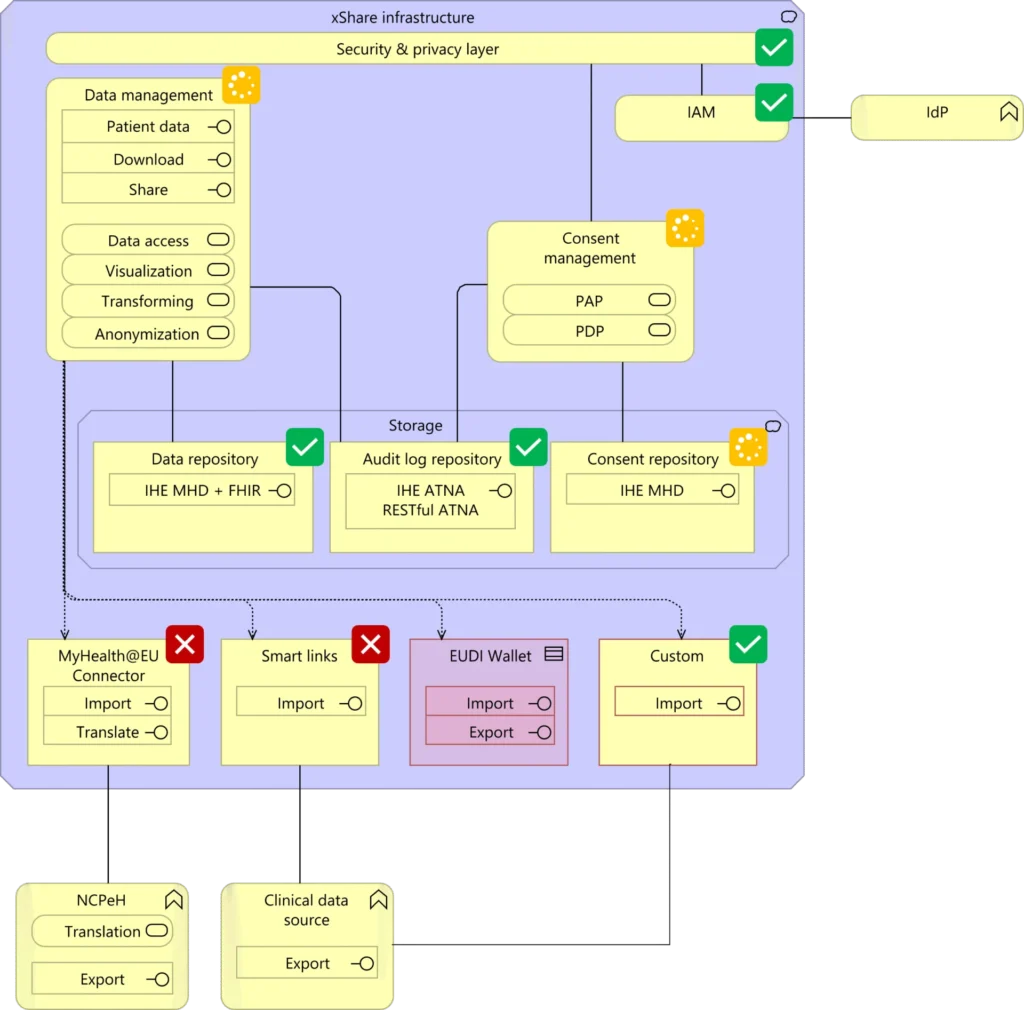
| Security, Privacy & Authentication | The MADEIRA Health Service implements robust security, privacy, and authentication measures to ensure the protection of sensitive health data and compliance with national and EU regulations, including GDPR. Citizens can access the patient portal and App through user/password authentication that requires a 2-point authentication according to data register upon the Regional Health System registration. |
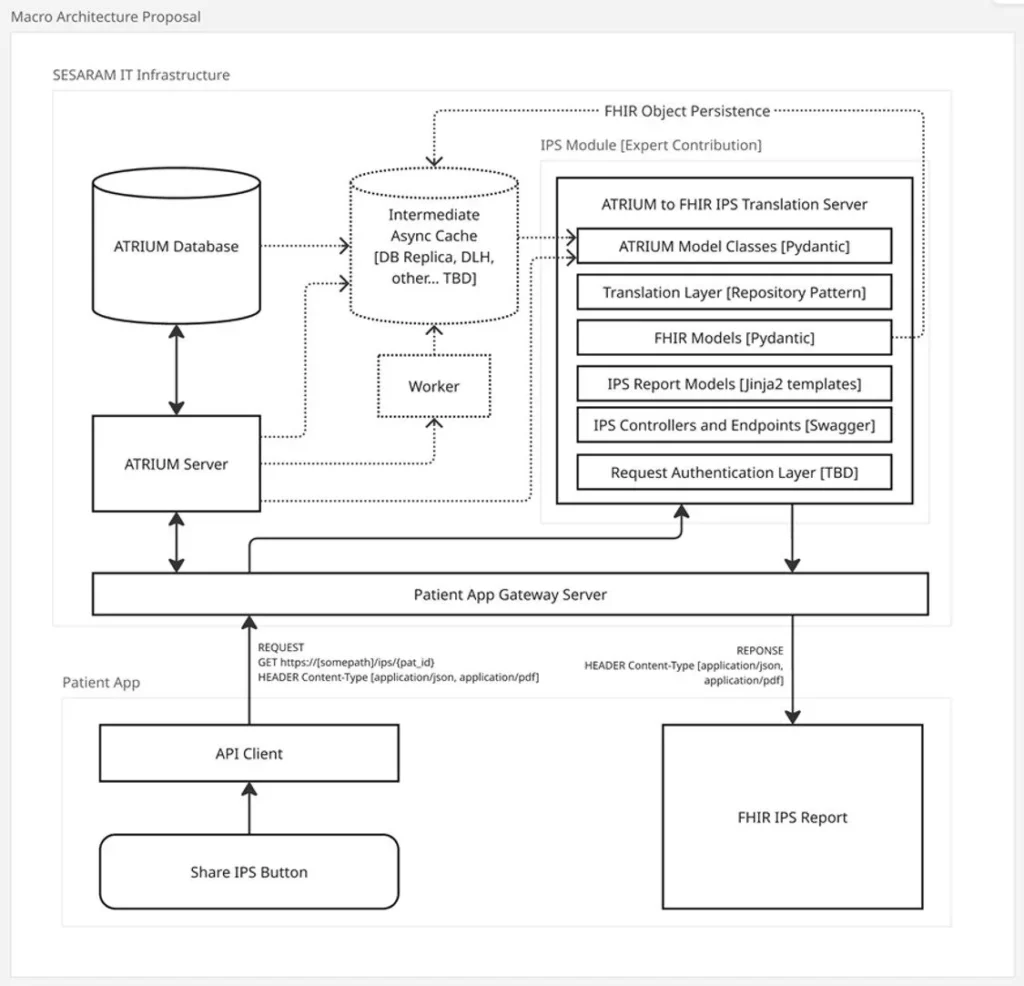
| Data Management | The MADEIRA Health Service has developed its own HIS, in which each patient has a unique EHR, featuring all medical records and social clinical data within the public health sector in which health data is structured. The ATRIUM to FHIR IPS Translation Server is the core component that handles communication between ATRIUM database and other services. This component manages data creation and transformations, returning only the necessary information to the patient portal. The patient has the possibility to download the health information in machine format and PDF. |
| Consent repository | The HIS in MADEIRA has a consent repository where the informed consents of each patient are stored. |
| Consent Management | The HIS in MADEIRA manages patient information in accordance with the informed consents provided by users. Patients have control over who can access their data, aligning with GDPR principles. All access and modifications to health records are logged and audited for compliance and security. |
| MyHealth@EU Connector | N/A |
| Smart Links | N/A |
| Data repository | The HIS comprises both primary and secondary healthcare services across the region. Patient records and health data are centralized in a structured data centre for health information in Madeira. Access to specific health data is restricted to authorized medical professionals and patients, ensuring secure login for healthcare professionals using multiple verification methods, where patients and professionals authenticate via national health cards or digital identity systems. |
| Audit repository | The MADEIRA health system manages internal audits to maintain and improve healthcare standards in its in-house developed HIS. |
As an implementation scenario, the next figure shows how the different blocks are implemented and interconnected in the specific case of this adoption site.
Timeline
- [M1-M6] Foundation and Previous work- Built upon previous regional initiatives on health data portability, leveraging synergies with other projects and existing HL7/FHIR-based developments for patient-requested health data exchange;
- [M3-M12] Business Use Case & Requirements- Developed, analysed and validated the xShare BUC, user requirements and implementation scenarios;
- [M9-M20] Health Data Assessment EEHRxF Mapping- Assessed, identified and mapped regional health data to enable generation of EEHRxF- compliant resources
- [M12-M18] IPS FHIR Modelling- Mapped the International Patient Summary (IPS) to HL7/FHIR, appraising on resources made available to users: patient, organisation, contact details, allergies, medications, active conditions and other mandatory IPS resources;
- [M12-M36] Patient-mediated Cross-border Care- Developed the cross-border use case between Madeira and a private healthcare provider in Catalonia, including the multilingual IPS, viewer adaptation, and end-to-end demonstration of patient-mediated heath data exchange;
- [M18-M20] IPS Implementation- Developed and implemented the IPS functionality, supporting the HL7/FHIR resources for the xShare Yellow Button, within the appSESARAM;
- [M19] IHE Plugathon 2025 Vienna- First interoperability validation of the IPS implementation. Successfully validated the generated IPS against EEHRxF specifications and obtained the xShare Silver Label for IPS Download;
- [M20-M24] xShare Yellow Button Integration-Integrated the xShare Yellow Button into the appSESARAM, enabling secure IPS download in both PDF and EEHRxF- compliant formats;
- [M22-M30] Demonstration & Validation- Demonstrated the xShare Yellow Button functionalities through project demonstrations and interoperability validation activities;
- [M28] IHE Plugathon 2026 Brussels- Advanced interoperability testing and validation of the integrated xShare Yellow Button within the appSESARAM, including IPS Download, Hl7/FHIR conformance, semantic and validation, confirming the maturity of the implementation and its readiness for real-world deployment. Successfully a xShare Silver Label was obtained for EHDS primary usage;
- [M24-M36] Interoperability Consolidation and Ecosystem readiness- Improved the quality, completeness, and semantic consistency of the IPS, strengthened HL7/FHIR outputs and prepared the regional ecosystem for patient-mediated exchange scenarios, promoting the adoption and consumption of EEHRxF compliant resources for broader adoption.
Kick-off – [M1-M6] Build on previous work aimed at health data portability, leveraging synergies with other projects where data from EHRs was mapped and transmitted in HL7/FHIR standards upon user request
Developing the xShare BUC [M6-M12]
Assessing and mapping health data to enable it to be downloaded in the EHRxF standard [M6-M20]
Evaluating the HIS systems from Madeira and Catalunya, establishing common ground, and defining the architectural steps for T3.5 and the xShare button functionalities demonstration [M11-M30]
Focus on Patient Summary data mapping to FHIR, appraising on resources made available to users: organisation; patient; main contact details; allergies; medication and active conditions [M12-M18]
Implementing the Patient Summary functionality and the FHIR resource for the xShare button, in the appSESARAM [M12-M20]
Integration of the xShare button in the appSESARAM [M12-M24]
First demonstration of the xShare button functionalities in the appSESARAM [M18-M20]
Show case the first results of T3.5 Patient-mediated use case: reaching out to medical tourism [M20-M24] between the Madeira and the Catalunya Regions
Further develop and demonstrations of the synergy between the MADEIRA and the Catalunya Regions by using the xShare button in medical tourism [M24-M30]
Demonstrations / interviews
Challenges and Remarks
The implementation of the xShare Yellow Button successfully demonstrated the feasibility of integrating the International Patient Summary (IPS) into an existing regional health ecosystem, despite the complexity of consolidating and harmonising clinical information from multiple systems into HL7/FHIR-compliant resources aligned with the EEHRxF. Participation in the IHE Plugathon played a key role in validating the solution, refining semantic interoperability, and increasing its technical maturity.
The work carried out has established a strong foundation for future deployment within the Regional Health System. Building on these achievements, future activities will focus on expanding interoperability services beyond the IPS, strengthening data quality and semantic interoperability, engaging additional public and private healthcare providers, and progressively aligning the Regional Health Information System with the EHDS Regulation and the evolving EEHRxF. These developments will further promote patient empowerment, continuity of care, and secure cross-border health data exchange, positioning Madeira as a reference regional ecosystem for the adoption of European digital health interoperability standards.