Denmark

Care plans are an electronic tool available to all general practices as part of a strengthened effort for chronic patients. It ensures that the patient gains an overview and understanding of their treatment and care of their illness, and it provides the best basis for self-care. The health professional content in the care plan is defined based on relevant guidelines and recommendations from Danish Society for General Practitioners, the Danish Health Authority, etc. Practices can also use the care plan module to create an overview of their chronic patients in their own practice.
Care plans provide an overview of the patient’s illness and key values that are significant for treatment and monitoring. The Care plan module can be used as a dialogue tool with the possibility of supporting the patient’s self-care and agreeing goals for the individual patient. Patients’ care plans can be shared with healthcare professionals at hospitals and municipalities via the national eHealth infrastructure, which contributes to coherent and coordinated patient care.
For patients, shared care plans help to clarify treatment goals and expectations. The alignment of these goals between general practitioners, specialists, and patients is particularly beneficial for chronic disease management, such as COPD or diabetes. By enabling all parties to track progress on agreed objectives, the electronic care plan fosters greater patient engagement and self-management. It provides patients with a clearer overview of their treatment journey, which is crucial in fostering better adherence to prescribed therapies and lifestyle adjustments.
All 1.700 primary care clinics in Denmark are integrated to the general care plan module. In May 2025 care plans are prepared and maintained for more than 250.000 individual patients with COPD, diabetes type 2 or heart failure.
Personas - use cases
Priority categories
Care plans (NEW)
Architecture
Electronic care plans have been implemented in all general practice clinics as part of a strategy to strengthen the effort for chronically ill patients. The care plans are shared via the national infrastructure as shown on the figure below.
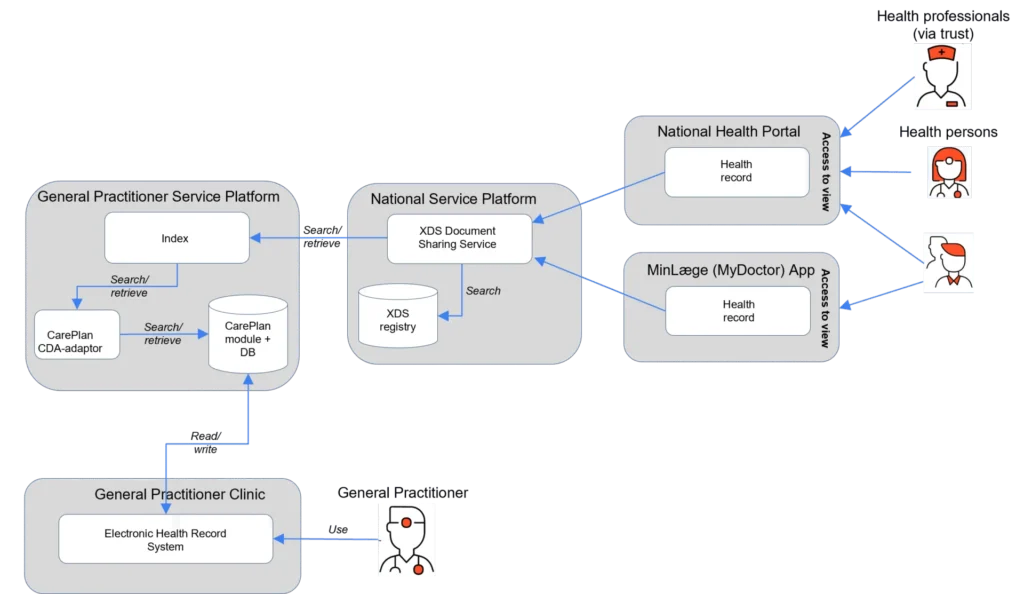
Denmark has appx. 1.700 Primary Care Clinics which all use an EHR system to document clinical care and treatment for individual patients. There are six different EHR systems provided by four different suppliers.
The electronic care plan tool is operated and maintained on the General Practitioner Service Platform. The electronic care plan is a common tool that is integrated into the six different EHR systems. The integration includes services to synchronize relevant data between the care plan tool and the primary care clinics.
The National Service Platform (NSP) provides business services and data collections for use by systems within the health domain. The NSP also provides XDS document sharing, which enables the sharing of care plans across sectors. Care plans are shared by using a Danish Profile for CDA (DK – Care Plan Document).
Sundhed.dk is the official National Health Portal for the public Danish Healthcare Services and enables citizens and healthcare professionals to find information and communicate. The portal facilitates patient-centred digital services that provide access to and information about the Danish healthcare services.
Health professionals, citizens and relatives can look up care plans. The care plan shows measurements and agreements made with the doctor. Healthcare professionals at hospitals and municipalities, among others, also have access to the care plan so that they can better coordinate your treatment and care.
Demonstrations / interviews
Challenges and Remarks
The Danish adoption site has focused on the existing national infrastructure for sharing electronic Care Plans and on how this experience can contribute to the development of a common European approach to structured Care Plan information.
Within xShare, Denmark does not demonstrate the Yellow Button functionality for Care Plans. Instead, experience from the Danish implementation has contributed to the xShare proposal for establishing Care Plans as a new Health Information Domain (HID) within the EHDS. This work includes a Care Plan logical model, an xShare Care Plan Implementation Guide and a Care Plan X-Bundle aligned with the evolving European Electronic Health Record Exchange Format (EHRxF).
A key challenge for future work is to align the existing Danish Care Plan infrastructure and data exchange with the emerging EHDS and EHRxF specifications. The Danish solution currently shares Care Plans using a national CDA-based profile, while future European exchange is expected to use structured and interoperable EHRxF specifications.
Future implementation of Yellow Button functionality for Care Plans in Denmark should therefore build on the Care Plan HID and the corresponding EHRxF specifications as these are further developed and adopted at European level.
Contact information
Morten Bruun-Rasmussen [email protected]