
On 26 May 2026, at the Medical Informatics Europe (MIE) Conference in Genoa, Italy, the xShare project brought together industry experts, researchers, and digital health advocates for an interactive workshop titled “The xShare Adoption Kit: From Understanding to Implementation – Educational Resources for European Health Data Interoperability.”
Led by a multidisciplinary panel including Syed Abrar Ahmed, Simon Lewerenz, Evangelos Markatos, and Catherine Chronaki, the goal of the session was to validate the ongoing development of the Adoption Kit and to make sure that the educational resources are aligned with the needs of the community.
Here are the insights, innovations and findings from this successful event.
The Core Challenge: Moving from Regulation to Real Adoption
While the EHDS Regulation and the European Electronic Health Record Exchange Format (EEHRxF) establish a framework for primary and secondary health data usage, bridging the gap between high-level policy and grassroots implementation remains challenging. Stakeholders often face technical complexity and a distinct lack of tailored educational resources.
The xShare project addresses these barriers directly through its ecosystem:
- The Yellow Button: A user-centric tool built into apps and websites that empowers citizens to securely access, download, and share their health data in the standardised EEHRxF format with a single click.
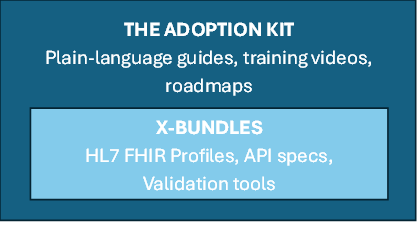
- X-Bundles: The foundational technical implementation assets, containing the core HL7 FHIR profiles, Implementation Guides (IGs), and validation tools necessary to link disparate IT systems.
- The Adoption Kit: The human-centric educational framework designed to translate those complex technical capabilities into clear, actionable resources for the community.
Live AI Content Multiplication
A major highlight of the workshop was a live demonstration led by Simon Lewerenz, showcasing the real-time multiplication of raw technical documentation into audience-targeted educational materials using Google’s NotebookLM. The exercise aimed to show how resource-strapped health initiatives can instantly generate audio summaries, scripts, and video content to fast-track stakeholder onboarding.
During the interactive feedback portion, participants evaluated this AI-driven approach. The live poll data painted a nuanced picture of audience perception:
Participant Agreement Levels on AI Content Creation
Attendees evaluated the effectiveness, user-readiness, and trustworthiness of AI tools on a 1-to-5 scale, which indicated that attendees considered AI tools effective for accelerating educational content creation from raw project data but did not trust AI-generated materials for professional or technical training.
Evaluation Metric | Average Score (out of 5) |
|---|---|
| AI tools are highly effective for accelerating educational content creation from raw project data | 4.1 |
| The AI-multiplied video format is consumer-ready and engaging for citizens | 3.5 |
| I would trust AI-generated materials for professional or highly technical training | 2.9 |
Furthermore, according to the open qualitative feedback, participants expressed distinct caveats alongside their optimism, which regarded human validation as non-negotiable, highlighted hallucination risks and the competency to create proper prompts. Below are some of the direct quotes from the attendees:
- “Needs rule book, curation oversight, be conscious of average,” and “Needs human validation”.
- “AI can help create learning materials… but hallucinations are a risk. All clinical content must be verified with trusted textbooks and peer-reviewed sources”.
- “People need to know how to use the right prompts to achieve high-quality results”.
What the Community Needs
To ensure the xShare Adoption Kit meets real-world training requirements, the workshop gathered live feedback regarding the learning formats and target pathways that should be prioritised moving forward.
Training Formats vs. Everyday Needs
During the workshop, participants rated how various mediums stack up for day-to-day continuous education:
- PDF Documents (Score: 3.7/5): Regarded as highly portable but noted for being difficult to read all the way through.
- Short Videos (Score: 3.5/5): Praised for offering high ease of understanding, though recognised as less portable for quick referencing.
- Audio/Podcasts (Score: 3.0/5): Valued for providing excellent ease of listening while multitasking.
However, when asked which type of content format helps them learn complex technical or regulatory health frameworks, the community’s demand shifted towards short, focused educational videos as the top priority, structured checklists as second, and technical walk-throughs as third, while comprehensive PDFs and audio summaries/podcasts came forth and fifth.
Focusing Developer for Yellow Button Implementation
For the tech community responsible for implementing the “Yellow Button” into commercial software, the workshop pinpointed where the xShare consortium can focus its engineering support:
- Top Priorities (Tie): Recorded step-by-step development/coding walkthroughs and an Interactive Chatbot linked directly to X-bundles.
- Secondary Priorities: Clear documentation on data architecture/SDK navigation and live technical demonstrations.
- Lower Urgency: Static compliance framework checklists.
In addition, when asked how useful would it be to have a dedicated webinar that demonstrates exactly how to technically implement the “Yellow Button” into an application, the attendees gave a strong score of 4.6 out of 5, validating the market’s urgency for hands-on, live-coded integration guides.
Healthcare Professional Pathway
There was also consensus that a dedicated educational push is needed for frontline healthcare workers. When asked how useful it would be to have a xShare Adoption Kit webinar specifically tailored for healthcare professionals, attendees gave a score of 4.7 out of 5 in agreement that a tailored clinical resource is necessary.
When asked about the precise material to feature, they revealed that the highest-priority topics are:
- Concrete clinical benefits and Time-saving elements (which tied for the highest demand).
- Legal and privacy implications.
- Patient empowerment workflows.
Conclusion
The MIE 2026 workshop proved that successful EHDS adoption relies as much on human education as it does on technological infrastructure. While AI tools present a valuable opportunity to scale up content generation rapidly, human curation remains essential to guarantee clinical accuracy and maintain stakeholder trust.
Moving forward, the insights gathered from MIE will help shape the xShare Adoption Kit. By prioritising short, clinically focused videos for practitioners and interactive, code-level walkthroughs for developers, xShare can turn European data interoperability from a complex regulatory requirement into an intuitive, accessible reality.
[ka1]Add link