
By Dimitris Georgoulis
Innovation Project Manager
Global Health Connector
Women interact with healthcare systems throughout every stage of life, from preventive screenings and reproductive health services to chronic disease management, maternity care, and long-term support. Yet despite major advances in digital health, healthcare journeys often remain fragmented, with health information spread across multiple providers, systems, and regions.
This fragmentation can create real barriers to access, continuity of care, and informed decision-making, particularly when people move between healthcare providers or across borders.
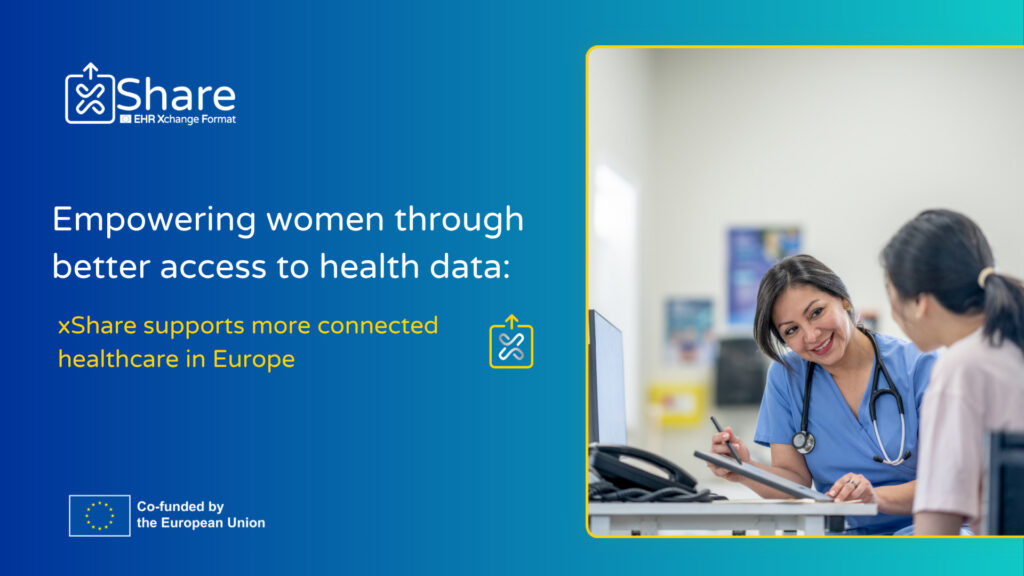
The xShare project is helping address this challenge by advancing a more connected, citizen-centred approach to health data sharing across Europe. Funded under Horizon Europe programme, xShare supports the implementation of the European Health Data Space (EHDS) vision through practical tools, interoperability standards, and real-world adoption activities designed to make health data more accessible, portable, and useful for both citizens and healthcare systems.
At the heart of the project is the vision that individuals are able to securely share their health data “with a click of a button.” Through the xShare Yellow Button, citizens can exercise greater control over how their health information is shared between systems and care providers, helping support safer, more coordinated, and more personalised care pathways.
For women’s health, this has important implications in everyday healthcare experiences.
For example, during pregnancy and maternity care, women often interact with multiple healthcare professionals and services, including GPs, gynaecologists, laboratories, maternity clinics, and hospitals. When records are fragmented, information may need to be repeated manually, tests duplicated, or important details transferred inefficiently between providers. More interoperable and portable health data sharing can help support better continuity of care and reduce administrative burden for both patients and professionals.
The same applies to women managing chronic conditions that require long-term follow-up across different specialists and care settings. Secure and citizen-controlled data sharing can help ensure that relevant health information follows the patient, supporting more coordinated and informed care decisions without requiring individuals to repeatedly gather records from multiple systems.
xShare also contributes to the broader European effort toward cross-border interoperability and the European Electronic Health Record Exchange Format (EEHRxF), helping create the conditions for authorised health information exchange between systems and countries. This can be particularly valuable for women travelling, studying, or working abroad who may need access to healthcare services away from their home country.
Preventive healthcare is another area where connected health data ecosystems can make a difference. Women regularly engage with screening and prevention programmes throughout life, including breast and cervical cancer screening. Better interoperability between screening services, primary care, and specialist providers can help strengthen continuity and accessibility across the care pathway, while also supporting citizens in accessing and managing their own health information more easily.
Beyond improving data exchange, xShare is helping strengthen the broader European innovation ecosystem around health data interoperability. Bringing together standards organisations, healthcare providers, public authorities, SMEs, industry actors, and digital innovators from across Europe, the project is working to create harmonised specifications, implementation tools, and support mechanisms that can accelerate trustworthy digital health innovation at scale.
Importantly, xShare is not only developing technical frameworks, but also demonstrating them in real healthcare settings across several European countries, including hospital networks, national health portals, regional healthcare ecosystems, and patient-facing digital applications. These adoption activities aim to show how interoperable health data sharing can improve experiences for citizens while supporting more efficient, resilient, and citizen-centred healthcare systems.
As Europe continues building a more connected digital health future, xShare highlights how interoperability, innovation, and citizen empowerment can contribute to more accessible and equitable healthcare for all, including women across diverse healthcare journeys and communities.
Learn more about the xShare project.